From December 3 to 9, two members of the War Childhood Museum (WCM) team, Ajla Fazlić and Hanan Alić, took part in the Balkanika Festival in Italy, where they presented the Museum’s work and led a series of peacebuilding activities with young people.
Peacebuilding Workshops with Italian Youth
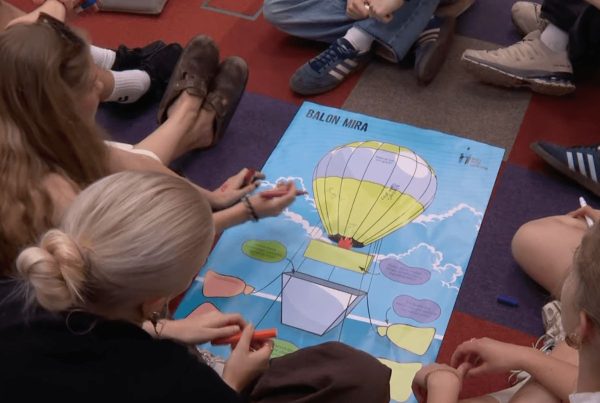
During the festival, Fazlić and Alić conducted peacebuilding workshops with students from three Italian schools, engaging more than 250 participants. Through interactive discussions and creative exercises, the workshops encouraged young people to reflect on peace, empathy, and the role of individual responsibility in building more inclusive and resilient societies.
Reflections from the Workshops
According to Ajla Fazlić, the most meaningful and impactful part of her engagement in Italy was the direct work with children and the reflections that followed each workshop.
“What stood out most was witnessing the moment when children articulated a change in their own thinking, recognizing peace as a fundamental value that is often taken for granted, yet in reality requires conscious care and protection. Moments like these reaffirm the long-term importance of educational work with young people and its potential to contribute to more sustainable and peaceful societies,” Fazlić said.
Through the Museum’s activities, she added, the focus was on conveying the vision and mission of the War Childhood Museum, while introducing participants to concepts of peace psychology, empathy, and a culture of peace.
Presenting the Museum and Bosnia and Herzegovina’s Post-War Reality
In addition to the workshops, Fazlić and Alić delivered presentations about the War Childhood Museum, the war in Bosnia and Herzegovina, and the social and political context of the country 30 years after the end of the conflict. These sessions provided Italian audiences with a broader understanding of war childhood experiences and the lasting consequences of conflict.
About the Balkanika Festival
The Balkanika Festival is organized by ISCOS Emilia-Romagna, with the support of the Emilia Romagna Region and in partnership with the City of Reggio Emilia, Fondazione Manodori, Anteas Emilia-Romagna, Giro del Cielo, Cuult, Orti Spallanzani, and numerous other partners. The festival brings together cultural, educational, and civil society actors to foster dialogue, solidarity, and intercultural exchange across borders.