Each year on June 19, the world marks the International Day for the Elimination of Sexual Violence in Conflict—a day dedicated to raising awareness about this form of violence, often used as a weapon of war, supporting survivors, and working to reduce the stigma they continue to face every day.
It was with this goal in mind that the War Childhood Museum created the exhibition “Speaking Out” in 2021, entirely co-created with women who survived conflict-related sexual violence and children born as a result of war. Since then, the exhibition has been presented to the public in Sarajevo, Mostar, and Belgrade, offering space for dialogue around a topic that too often remains unaddressed.
From Gender Justice to Sustainable Peace
The most recent edition of the exhibition was held from June 12 to 18, 2025, at the European House of Culture and National Minorities in Sarajevo, as part of the cultural-educational program “Women Lead. Peace Follows.” This program accompanied the international conference “From Gender Justice to Sustainable Peace: A 25-Year Vision”, jointly organized by the Ministry for Human Rights and Refugees of Bosnia and Herzegovina and the United Nations in BiH, under the initiative “Women Lead on the Path to Peace and Security in Bosnia and Herzegovina,” implemented by UN Women, UNFPA, and IOM, with support from the UN Secretary-General’s Peacebuilding Fund (PBF). The conference was additionally supported by the Ministry of Foreign Affairs of Denmark.
Our bodies are not just bodies. They are archives. Maps. They carry stories the world often refuses to hear. Through body mapping, we are not asking for pity. We are asking for truth. For visibility.
— Midheta Kaloper, survivor and co-author of the exhibition
Survivors’ Voices in Public Space
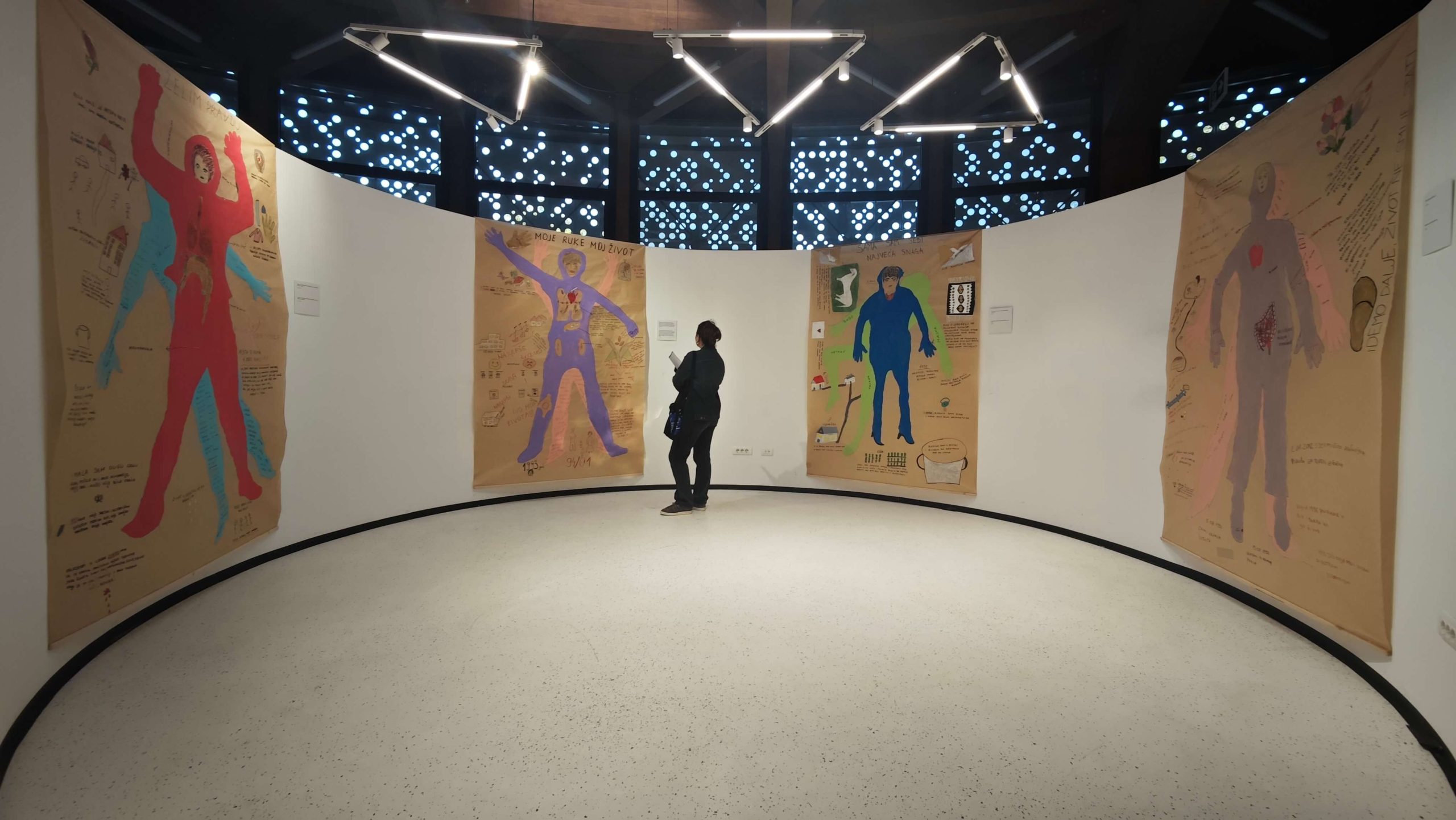
Through personal testimonies, objects, and excerpts from video testimonies, Speaking Out created space for experiences that are rarely acknowledged. At the heart of the exhibition were body maps, created during artistic-documentary workshops, enabling survivors to express their experiences in ways that do not require verbalizing trauma.
These stories are part of us—transferred onto paper so that each visitor may receive a message and a lesson: that these are women of strength who have mapped out their own stories. Sometimes, in life, it is easier to express so much on paper than to speak it aloud—so that visitors may understand the weight and depth of our stories, our pain, our joyful moments, and our struggle.
— Midheta Kaloper
Amina Krvavac, Director of the War Childhood Museum Bosnia and Herzegovina, emphasized that the body mapping methodology, through the use of life-sized body outlines, allows for a space to map pain, memories, and key life events without having to verbalize them.
This methodology offers survivors a chance to reflect on their entire life story. In doing so, they no longer see themselves solely through the lens of having survived sexual violence, nor is their identity reduced to that trauma. Instead, they recognize that they are so much more. It is essential that they find their inner strength and speak about their experiences—because through that visibility, we can all contribute to their fight for justice and against stigmatization.
The exhibition was the result of months of collaboration between the Museum and associations including Forgotten Children of War, Wings of Hope, Psiholab, and individual survivors’ groups. In addition to women’s testimonies, a crucial part of the exhibition focused on the voices of children born as a result of wartime sexual violence—individuals whose existence is still socially marginalized.
Space for Dialogue
The closing of Speaking Out does not mark the end of the need for truth, nor the end of the call to action. On the contrary, June 19 reminds us how important it is to continue talking about conflict-related sexual violence—without stigma, without silence, without turning away.
In Bosnia and Herzegovina, systemic support for survivors and children born of war is still lacking. Exhibitions like this demonstrate that cultural institutions play a vital role in recognition, documentation, and opening space for dialogue. They invite us to listen and not to forget.