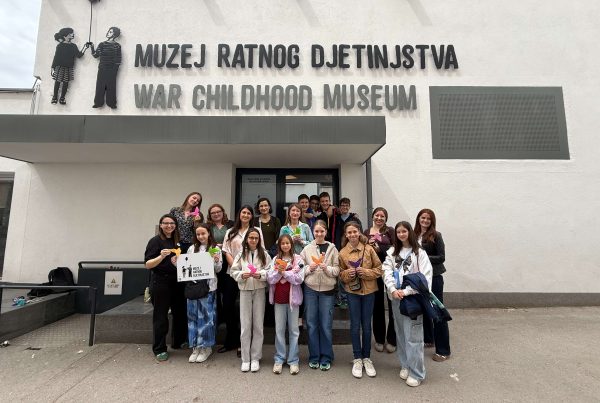
Last week, 25 members of the Children’s Parliament from Gorazde visited the War Childhood Museum. This unique platform brings together upper-grade students of primary schools in Gorazde to discuss their rights, needs and aspirations with representatives of public institutions and authorities.
The children were accompanied by the president of the association, Slavko Klisura, and assembly member Vildana Obuca. The Children’s Parliament from Gorazde operates under the European Association for the Creative Development of Children, with meetings often dedicated to the importance of the culture of remembrance and peace.

A visit to WCM as a reward for their efforts
“This visit is a reward for their hard work in the parliament. We often discuss topics that they can’t find in textbooks. Children need to know the truth, to serve them as a tool for building peace,” says Klisura.
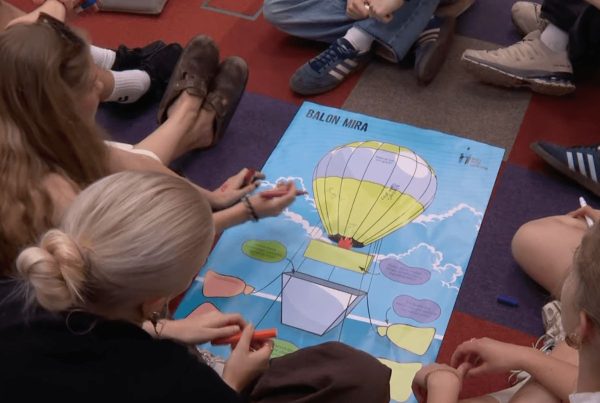
Peace education is the primary reason for their visit. After exploring our permanent exhibition, the children, divided into two age groups, participated in our peacebuilding workshops. They engaged in activities suited to their age, playing and laughing while discussing the exhibition. They talked about experiences with children who grew up in war and reflected with our educators on the importance of contributing to peacebuilding.


Member of the Children’s Parliament assembly, Vildana Obuca, also attended the workshops.
“This is my first visit, and I am impressed. The exhibition, the museum itself, brought a special feeling to me and the children. As I was born in 1982, memories of my childhood came back to me. I was even younger when the war started. I’m glad that children have the opportunity to understand how we lived, socialized, and ultimately created our own games. I sincerely hope that all schools in Bosnia and Herzegovina will include a visit to WCM in their annual plans,” says Obuca.


WCM Upcoming Exhibition in Gorazde
Among the 6,000 objects and stories in our collection are those about the siege of Gorazde, such as Amina’s “Teddy’s Sweater.”

Teddy’s Sweater
I was ten when the war started. I was in Goražde the whole time. The city was under siege for four years, meaning we were without water, power, and heating. Shelling was a daily occurrence.
My parents were doctors so I spent a lot of time with them in the clinic. When the shelling would start, we would go hide in dark, cold basements. In our building’s basement, women knitted socks, caps, gloves… They would knit for hours next to an oil lamp – light from an oil lamp came only after you poured in half a glass of water, added oil, and then used a piece of linen as a fuse. It produced a lot of soot, so we would always leave the basement covered in it. The women unraveled old clothing to make new things, because there was no other way of getting yarn. With knitting, our time in the basement seemed shorter and it was easier to handle fear, hunger, and the sound of explosions outside. My mother knitted too, and so she gave me a couple of needles, some yarn, and with her help I learned to knit.
I knitted this sweater for my teddy bear whom I carried with me everywhere. Everyone gave me some of their yarn, which came in various colors, so the sweater I knitted turned out colorful. The front, the back, and the sleeves are in many different shades. I kept it to this day, so that I could have one wonderful memory amid all the bad ones – it would remind me that I, a child living in those conditions, learned a valuable skill.
Amina (b. 1982) Gorazde
Amina’s ‘Teddy’s Sweater’ will be featured at the War Childhood Museum’s upcoming exhibition at the Cultural Center in Gorazde, which we are organizing in collaboration with the Homeland Museum Gorazde. This will be our first exhibition in this Bosnian town and will be dedicated to childhood under the sieges of Gorazde, Sarajevo, Gaza, and Mariupol.
The exhibition will run from July 15th to August 15th, 2024.
If your childhood was affected by war, you can contribute your memories to the WCM. For more information, contact us at +38765912326 or ivana.roso@warchildhood.org.