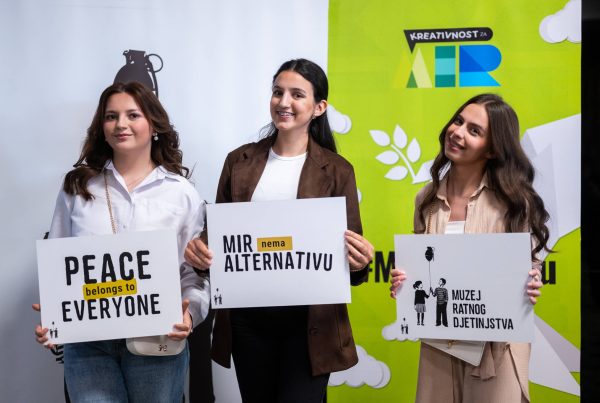
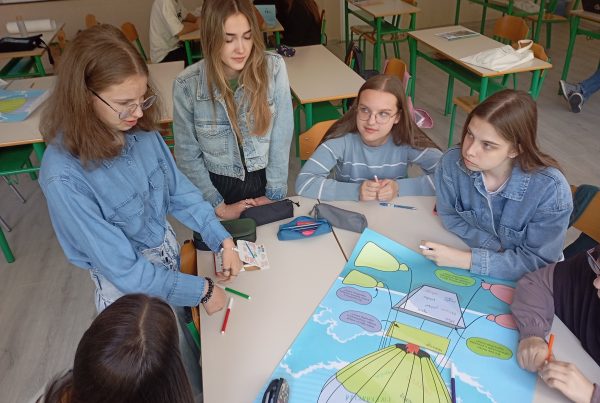
In classrooms across Bosnia and Herzegovina, students teach their peers about peace. Through stories from the War Childhood Museum collection, they open conversations about how armed conflicts affect children and civilians, encourage the exchange of views, and foster empathy.
These workshops are part of the “Creativity for Peace” program, through which we have trained more than 240 teachers and professors together with their students. After completing the trainings, participants continued to pass on the knowledge they gained in their schools and communities. In this way, knowledge that began in training rooms has reached more than 12,000 students across Bosnia and Herzegovina.
As part of the program, participants keep diaries in which they reflect on their experiences of leading workshops and on peace more broadly.
In Tuzla, Ajla Džambić, a student at the Secondary Medical School, points out that promoting peace does not necessarily mean resolving major conflicts. Often, she says, it is about giving someone space to express themselves, to be heard, and to be understood.
“It is not easy to introduce new things into an established system. Some people may still not understand what we do, or why we do it. And that is okay. If we are truly committed to peace, that also means patience, persistence, and a willingness to accept challenges—even those that disappoint us,” Ajla says, speaking about her experience of leading workshops.
For her, the very process of teaching others also brought new insights and personal growth.
“We realized how unique each person is and how much we need to adapt to each individual in order to create interaction,” she adds.
Similar experiences are shared by Mak Dujković, a student at the Third Gymnasium in Sarajevo, who describes one moment from a workshop that particularly stayed with him.
“During one workshop at my school, I was especially struck by a conversation with a student who is generally known as rebellious and who openly expresses nationalist views. During the discussion about identities, conflicts, and borders, he asked provocative questions and defended the idea of territorial expansion as a ‘necessary right of a people’. Instead of immediately challenging him, I decided to listen and ask questions that led him to reflect more deeply on his own views.
At the end of the workshop, he approached me and said that for the first time he had realized how limiting those views actually were, and that they had led him more toward conflict than toward self-development. He said he understood that no ‘territorial expansion’ would help him become a better version of himself, nor would it bring him personal peace or meaning. That moment showed me that change is not always immediate, but that honest conversation and space for reflection can have a deep and lasting impact.”
Through the workshops, Ajla also had the opportunity to see how conversations about peace affect their peers.
“At the end of the workshop, someone said: ‘We never do this. We never talk like this. But we should do it more often.’ That sentence stayed with me. It was confirmation that this workshop was not just another school activity, but a moment of real change—maybe small, but important.”
In Banja Luka, another peer educator continues to spread similar ideas. Armin Husić from the Catholic School Centre “Ivan Merz” says that participating in the program encouraged him to think about long-term engagement in peacebuilding.
“I can imagine myself doing this even ten years from now, preferably with a slightly older group. The meaning of everything said in the name of peacebuilding finally sheds its layer of abstraction and takes on a concrete, physical form,” Armin says.
The experiences from the program are also reflected through the perspectives of teachers. Atina Mušić, a teacher at the “Mirsad Salkić” Primary School in Bužim, says that as an educator she is often repeatedly surprised by how deeply and thoughtfully young people can reflect on the world they live in when they are given space and a sense of safety.
“These workshops showed me that children can be agents of change if they are trusted and listened to. And that the past, no matter how heavy, can become a bridge to the future if it is shared in the right way.”
Working within the program brought her, she says, a deep sense of purpose, because “working with children today means building the foundations of peace for tomorrow.”
The workshops are ongoing, and conversations about peace continue in over 60 schools across the country.