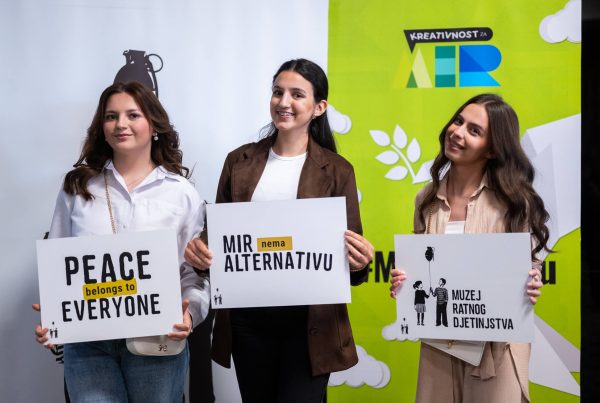
Last week, the War Childhood Museum team welcomed two new colleagues for the day – secondary school students Tajra and Amila, who joined us as part of Social Day, an initiative run by the Association of Secondary School Students in Bosnia and Herzegovina (ASuBiH).
They began their working day at the Museum’s office, where they met members of the program team and learnt more about the Museum’s work – from collecting objects and working with the archive to developing programmes and engaging with audiences.
One of their tasks was to suggest ways to make the Furaj mir platform more engaging for members of their generation.
Their ideas and observations offered additional insight into how young people communicate today, what matters to them, and how we can engage them in conversations about peace.
 Discovering the Museum from a Different Perspective
After spending the morning at the office, they visited the War Childhood Museum’s exhibition and learnt about the work of museum guides. They spoke with our guides Kenan and Hanan about their daily responsibilities, working with visitors, and the experiences that come from meeting people of different generations and from different parts of the world.
For Tajra, the day offered much more than an introduction to the workplace.
‘My plan was just to miss a day of school and get out of a physics test, but I ended up learning something much more important – how to build peace,’ she reflected.
She explained that the experience had given her a sense of what it is like to work with people and a better understanding of the daily lives of Museum staff. She particularly enjoyed the atmosphere and would happily return.
Amila was also surprised by how much she enjoyed working at the Museum. She particularly valued the opportunity to talk to staff and share experiences.
‘We also spoke with people from different parts of the world who had come to visit the Museum. The day went by quickly, and I would definitely do it again.’
Learning Beyond the Classroom
Social Day gives secondary school students the opportunity to spend a day in the workplace, explore different professions and gain experience beyond the classroom. It also allows host organisations to hear how young people think, what interests them and how they see the world around them.
We are particularly pleased that our guests devoted part of their day to considering how to make peacebuilding more relevant to their generation. Their observations remind us how important it is to give young people space to play an active role in shaping our programmes.
Employers hosting secondary school students during Social Day contribute the students’ wages for the day to the Social Day Fund. The funds raised support young people in launching initiatives and addressing issues they identify in their communities.