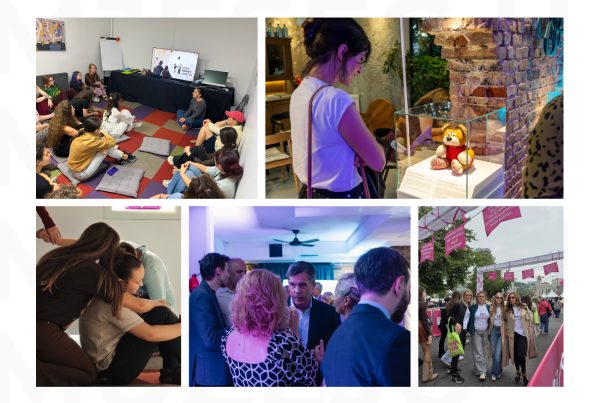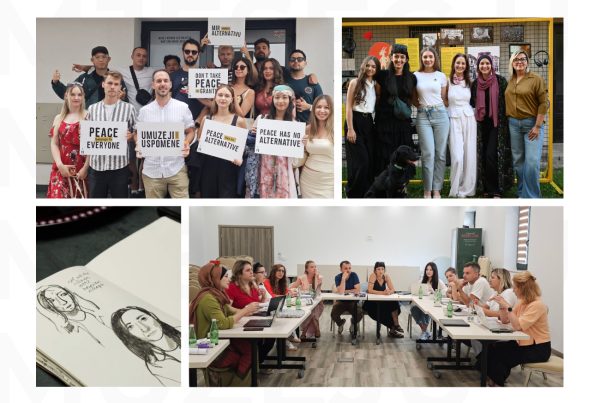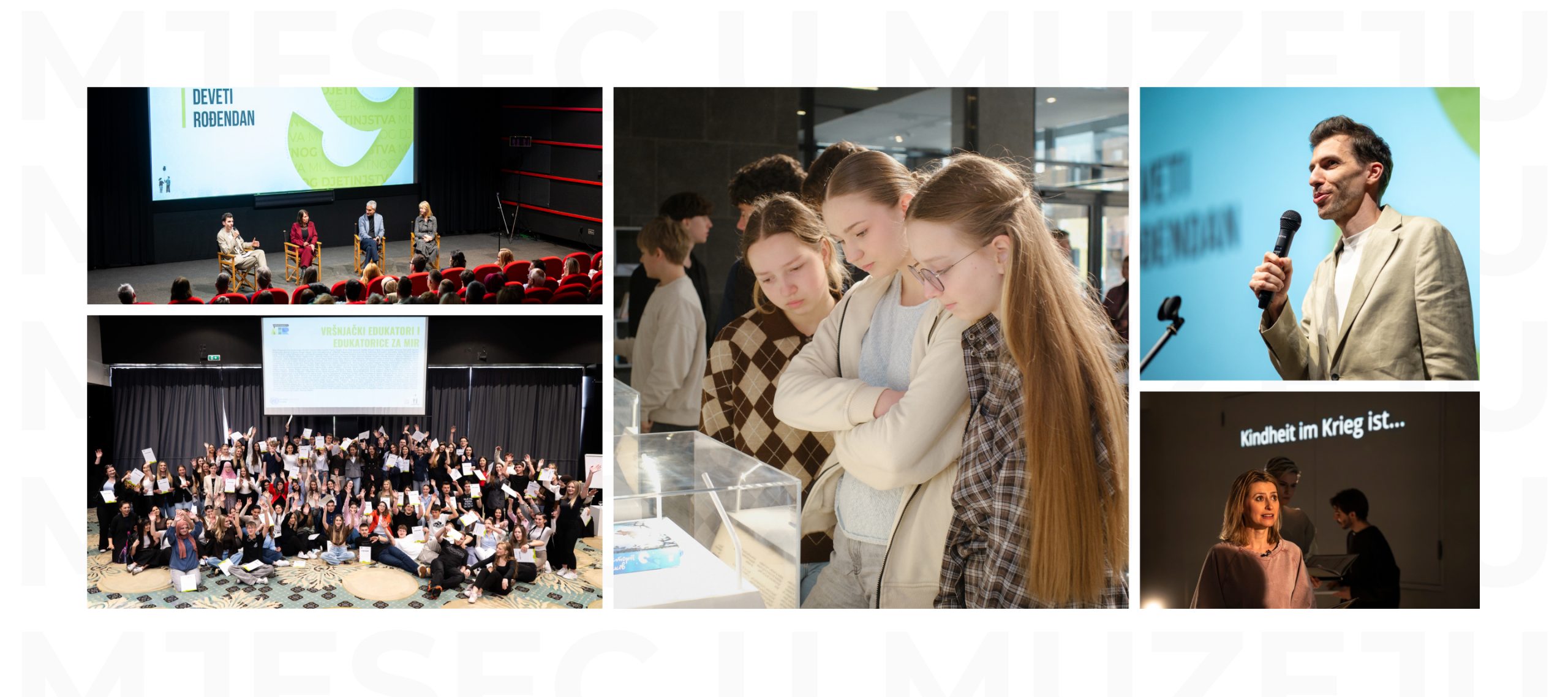
This April, the War Childhood Museum marked its ninth anniversary through educational activities, international collaborations, public discussions, exhibitions, and youth-led peacebuilding initiatives across Bosnia and Herzegovina and beyond.
Read more about our activities this month:
Educational Programs and Visits
During April, we welcomed almost 50 educational groups from Bosnia and Herzegovina, Croatia, the Netherlands, the United States, North Macedonia, Italy, Sweden, Denmark, Germany, and Czechia. Through guided visits and conversations, participants engaged with the Museum’s collection and reflected on the experiences of children growing up in war.
In collaboration with the Jesuit Refugee Service (JRS), we organized an educational visit and guided tour for unaccompanied minors from Sudan, Morocco, and Syria, together with students from local schools in Bosnia and Herzegovina.
We also welcomed Doris Schmidauer, the First Lady of Austria, accompanied by Mirela Bećirović, spouse of the Chairman of the Presidency of Bosnia and Herzegovina. During the visit, our Director for Bosnia and Herzegovina, Amina Krvavac, guided guests through the permanent exhibition and opened conversations about children’s rights and childhood in war.
Ninth Anniversary
In April, we marked the Museum’s ninth anniversary with a week of activities held from April 13–17, 2026. The program included workshops, educational activities, and public conversations with international guests.
Activities throughout the week included peacebuilding workshops for high school students, educational programs for blind and visually impaired children and youth, an international peacebuilding workshop, workshops with peer educators, and creative activities for preschool children.
As part of the central program, researchers from Palestine and Ukraine joined the Museum in Sarajevo to present how new objects continue to enter the collection from contemporary conflicts. We also hosted guests from the Netherlands, South Africa, and Portugal to discuss the Museum’s international development and future collaborations. At the same time, children and young people from Bosnia and Herzegovina presented the Museum’s peacebuilding program, currently implemented in more than 50 communities across the country.
Conferences, Seminars, and Public Programs
On April 27 and 28, Sarajevo hosted the closing event of the “Creativity for Peace” program, which brings together teachers and young people from across Bosnia and Herzegovina with the goal of strengthening peace education. More than 150 peer educators and teachers from across the country gathered to exchange experiences, present the results of their work, and discuss the future of peace education in schools.
Our Research Coordinator, Ajnura Akbaš, also held an online presentation on trauma-informed archiving as part of the Survivor-Centred Visual Narratives project.
Meanwhile, our Director for Bosnia and Herzegovina, Amina Krvavac, participated in the session of the Parliamentary Assembly of the Council of Europe in Strasbourg, representing the European Museum Forum in her role as Chair. During the session, she addressed the Committee on Culture, Science, Education and Media on the role of museums in strengthening democratic values and fostering more connected societies.
On April 23, we also marked World Book Day by reflecting on the role books play in the lives of children growing up in conflict, where reading can become a source of comfort, imagination, and emotional refuge.
Exhibitions and Youth-Led Initiatives
As part of our “Furaj mir” (“Live Peace”) program, youth teams from different cities across Bosnia and Herzegovina opened five exhibitions exploring peace, memory, identity, and belonging.
In Tešanj, young people opened the exhibition “MiRazličiti,” (“Peace in Difference”) exploring how differences can connect rather than divide communities. The exhibition reflects on life in a community shaped by different identities, customs, and experiences, and what it means to truly live together.
In Teočak, the exhibition “Priče iz kofera” (“Stories from a Suitcase”) focused on young people who leave, stay, or search for a sense of belonging. Developed through conversations with youth from five municipalities in the Majevica region, the exhibition explored migration, uncertainty, and attachment to place.
In Bugojno, the exhibition “Mi(r) kad profesori ne gledaju” (“Peace When the Teachers Aren’t Watching”) examined the everyday lives of high school students navigating division within the education system while continuing to build friendships and shared spaces beyond imposed boundaries.
In Prnjavor, the exhibition “Nekad se zakuha” (“When Things Come to a Boil”) used food as a starting point for conversations about war, displacement, survival, and peace. Through everyday ingredients such as rice, potatoes, and pasta, the exhibition reflected on memories of scarcity, leaving home, and rebuilding life.
In Prozor-Rama, the exhibition “Zaroni u prošlost, izroni u budućnost” (“Dive into the Past, Emerge into the Future”) explored questions of memory and identity in a landscape transformed by the creation of an artificial lake. Using butterflies as a symbol of change, memory, and hope, the exhibition reflected on what remains even when physical spaces disappear.
In Ukraine, the War Childhood Museum Ukraine opened the exhibition “Books That Walk With You Through War” in Chernivtsi. The exhibition features personal stories and objects from 15 children and teenagers for whom books became an important source of support during wartime. Alongside the exhibition, public programs for children and adults explored literature, empathy, and the role of reading in difficult circumstances. The exhibition is supported by the ProPeace Programme Office in Ukraine in partnership with the Ivan Mykolaichuk Cultural and Art Center.
Events
On April 1, the NS-Dokumentationszentrum München hosted the multimedia staged reading “I’m sick to death of war and shells, of big ‘men’ selling lies,” based on testimonies from “War Childhood” by Jasminko Halilović. Performed by Ivona Baković, Maja Zećo, and Enes Şahin, the reading brought memories of Sarajevo to new audiences in Munich through a combination of testimony, sound, and performance.
Media Mentions
The War Childhood Museum continued to receive attention in both Bosnian and international media throughout April. Below is a selection of coverage from the past month: