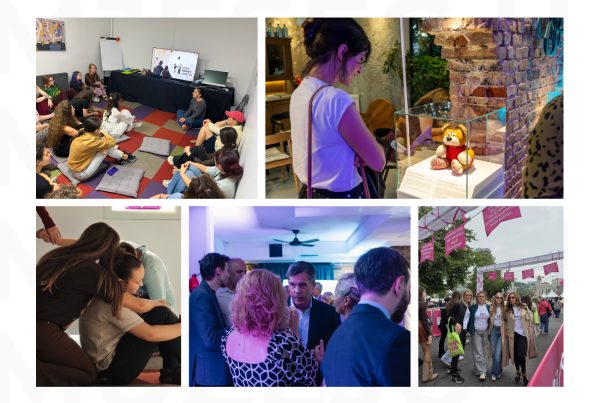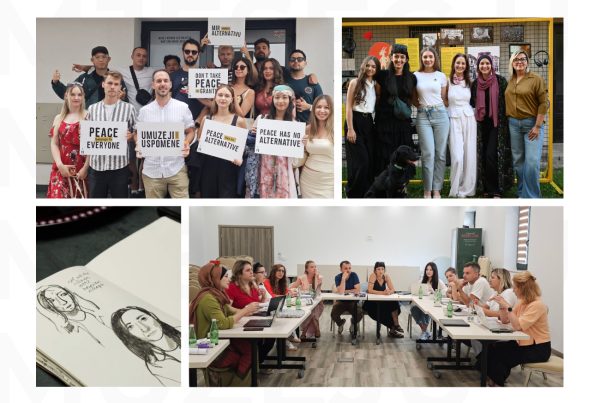
This May, the War Childhood Museum continued its work through educational programs, international visits, conferences, exhibitions, youth-led peacebuilding initiatives, and international recognition for innovative projects amplifying the voices of children affected by war.
Read more about our activities this month:
Educational Programs and Visits
Throughout May, we welcomed educational groups and visitors from Bosnia and Herzegovina, Croatia, Germany, Kosovo, Albania, Montenegro, the United States, Turkey, Italy, and Slovakia.
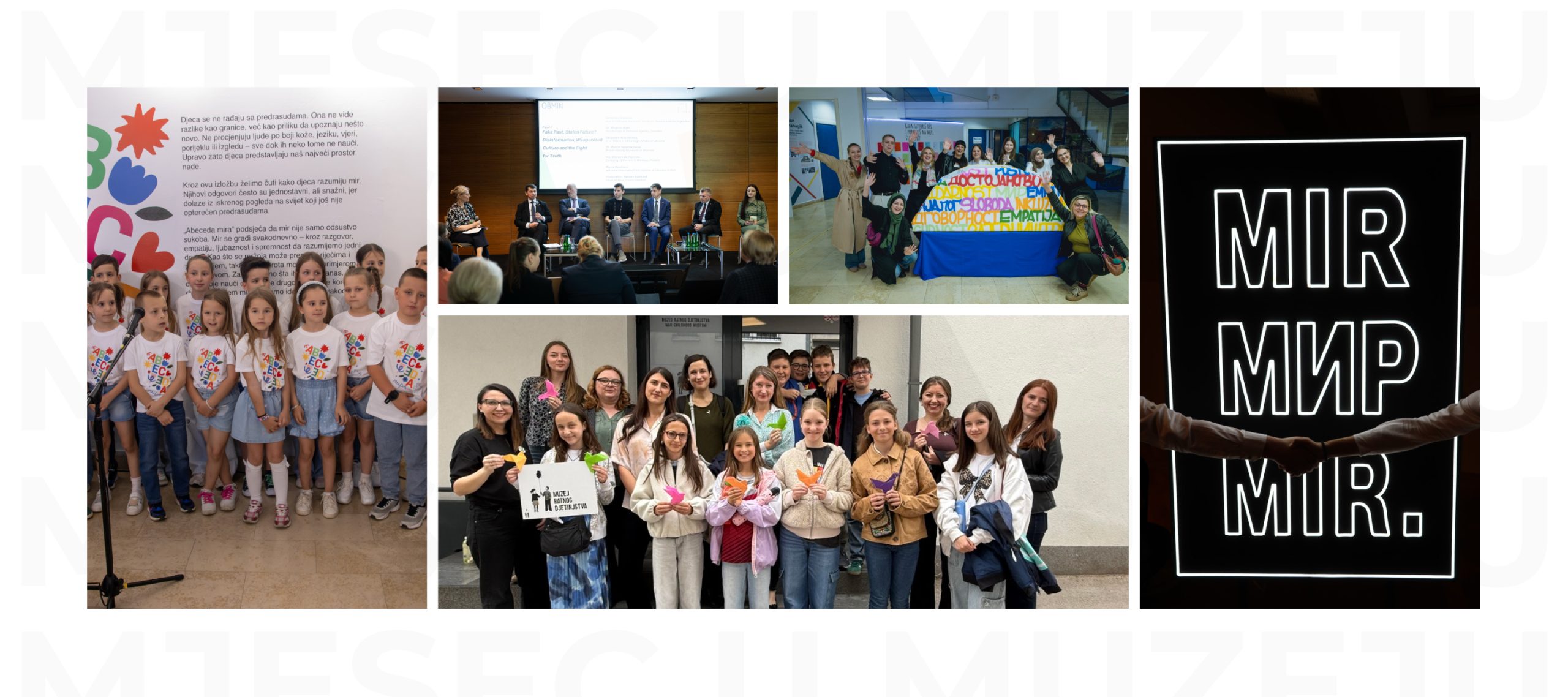
As part of the global “Prove It Matters” campaign launched by the Office of the Special Representative of the United Nations Secretary-General for Children and Armed Conflict, the WCM welcomed students from Hasan Kikić Elementary School in Sarajevo for a workshop focused on peace, children’s rights, and the importance of ensuring that children’s voices are heard. The campaign calls on world leaders to reaffirm their commitment to protecting children and upholding the UN Convention on the Rights of the Child, while also encouraging children around the world to share their own messages of peace.
In May, we also welcomed a delegation of the Committee on Foreign Affairs of the Parliament of the Kingdom of Sweden during their visit to Bosnia and Herzegovina. The twelve-member delegation was received by the Museum’s Director for Bosnia and Herzegovina, Amina Krvavac. Discussions focused on the Museum’s mission, the importance of preserving and sharing children’s wartime experiences, and the role of memory work in building more peaceful societies.
Conferences
On 7–8 May, Jasminko Halilović, Founder and Director-General of the War Childhood Museum, participated in the second annual Ukraine Cultural Security Forum in Warsaw, Poland.
As part of the panel discussion “Fake Past, Stolen Future? Disinformation, Weaponized Culture and the Fight for Truth,” Halilović joined representatives of leading museums and cultural institutions, the Vice-Minister of Foreign Affairs of Ukraine, and the Ambassador of France to Poland. The discussion explored the role of cultural institutions in confronting disinformation, protecting historical truth, and safeguarding cultural heritage during times of conflict.
Exhibitions and Youth-Led Initiatives
As part of the “Furaj mir” (“Live Peace”) program, youth teams from across Bosnia and Herzegovina continued to explore peace, identity, memory, and belonging through community-based exhibitions.
On 9 May, the exhibition “Perspektiva” opened at the Cultural Center in Srebrenica. Through art and documentary materials, the exhibition presents stories and perspectives gathered by young people from Bratunac and Srebrenica, creating space for dialogue, encounter, and reflection on a shared future.
On 11 May, the exhibition “Pod istim mirom” (“Under the Same Peace”) opened in the Milanović House Atelier in Banja Luka. Through photography, video, and personal testimonies, the exhibition explores different experiences of community, peace, and everyday life within a shared society.
On 20 May, young people from Modriča and Gradačac opened the exhibition “Sve(mir) među nama” (“Peace Among Us”) at the Serbian Cultural Center in Modriča. Drawing on conversations with residents from both communities, the exhibition transforms personal stories, reflections, and experiences into photographs and messages about peace, closeness, and mutual understanding.
On 22 May, the exhibition “Krivaja grad(i) mir” (“Krivaja Builds Peace”) opened at the Cultural and Sports Center in Zavidovići. Through photographs, interviews, and a central installation made from wood, young participants explored how the Krivaja industrial complex shaped the city’s history, memories, and sense of community, while reflecting on the connections between economic wellbeing, belonging, and peace.
In Ukraine, the War Childhood Museum Ukraine concluded the exhibition “Books That Walk With You Through War”in Chernivtsi with a public reading of the book With Love, Dad (З любовʼю — тато). The event featured a conversation with the author and serviceman Valeriy Puzik, moderated by Svitlana Osipchuk, Program Director of the War Childhood Museum Ukraine. The exhibition was developed with the support of the ProPeace Programme Office in Ukraine in cooperation with the Ivan Mykolaichuk Cultural and Art Center.
Awards and Special Projects
In May, the War Childhood Museum’s video game “We Grew Up in War” was selected as one of ten recipients of the 2026 Unity for Humanity Grant. The game was developed through collaboration with partners from the Czech Republic, studio Charles Games.
Chosen from more than 500 applications worldwide, the project received funding and technical support through Unity’s flagship social impact program, which supports creators using real-time 3D technology to advance the United Nations Sustainable Development Goals. The recognition will support the continued development of the game and expand its ability to engage audiences with stories of childhood affected by war through innovative digital storytelling.
Media Mentions
The War Childhood Museum continued to receive attention in both Bosnian and international media throughout May. Below is a selection of coverage from the past month:
- From Kyiv to the Balkans: How a Museum Opened My Eyes to Shared Wartime Childhoods
- Decoder Replay: The children of war
- War Childhood Museum as a Guardian of Memory and a Voice for Children Affected by War | Preporod.info (BOSNIAN)