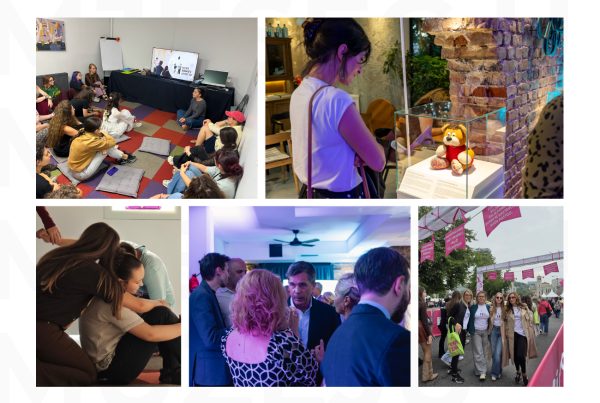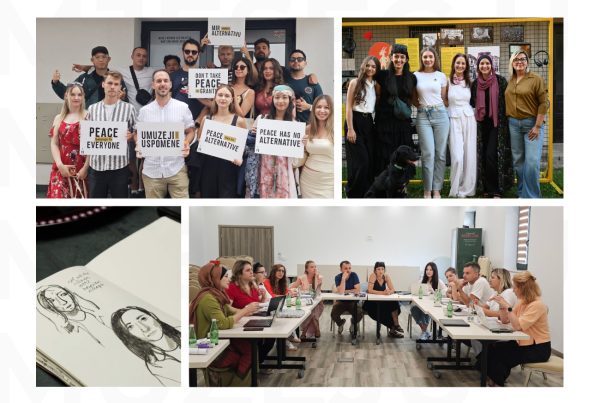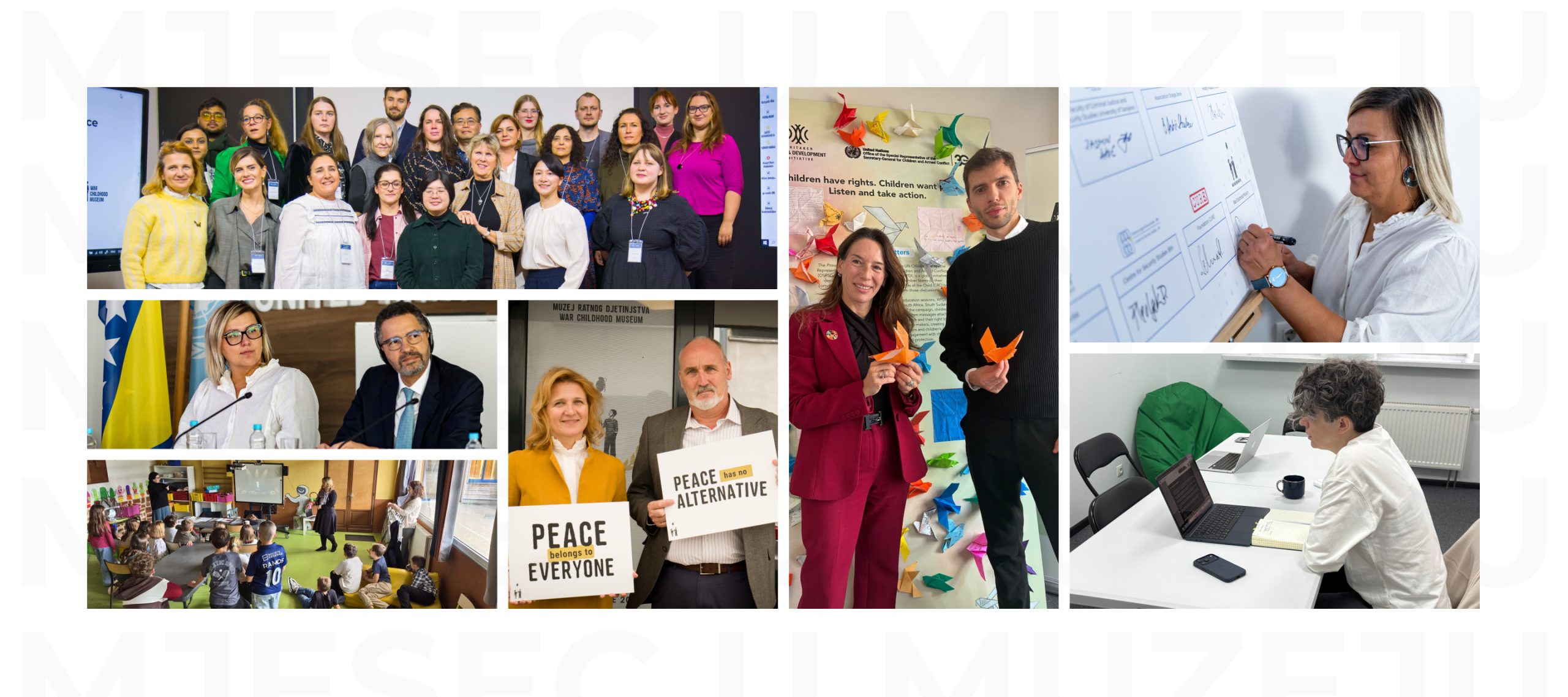
This October, the War Childhood Museum continued its work through educational visits, international conferences, peacebuilding initiatives, research, and institutional cooperation. Throughout the month, we engaged with children and museum professionals across Europe, contributed to international conversations on memory and conflict prevention, strengthened partnerships, and highlighted stories from our collection.
Read more about our activities this month:
Educational Programs and Visits
Throughout October, we welcomed educational groups and visitors from Denmark, Serbia, Italy, Czechia, Croatia, Scotland, Qatar, France, Sweden, Germany, Slovenia, Portugal, North Macedonia, the United States, Thailand, the Netherlands, and Latvia.
The Museum also welcomed Gabriele Derighetti, Ambassador of Switzerland to Bosnia and Herzegovina, who explored our permanent exhibition and reflected on the stories conveyed through everyday objects, his own childhood memories, and the importance of protecting children affected by conflict. Read our interview with Ambassador Derighetti or watch the video from his visit.
In October, we also welcomed two new colleagues for a day: Tajra and Amila, secondary school students who joined our team as part of Social Day, an initiative organized by the Association of Secondary School Students in Bosnia and Herzegovina (ASuBiH). Read about their experience and what they learned about the Museum’s work.
International Conferences and Events
On October 27–28, the War Childhood Museum partnered with the International Council of Museums’ International Committee on Ethical Dilemmas (ICOM ICEthics) to organize the international conference “Echoes of Conflict, Paths to Peace: Museums, Memory, and Post-War Recovery” in Sarajevo.
The conference brought together museum professionals, researchers, and heritage practitioners from around the world to discuss the role of museums in preserving difficult histories, addressing the legacies of conflict, and contributing to peacebuilding. Discussions explored the ethical responsibilities of cultural institutions and their potential to foster dialogue and understanding in societies affected by conflict. Read more about the conference or take a look at the highlights.
The War Childhood Museum also participated in the seventh edition of the “Foutez-nous la Paix!” (“Leave Us in Peace!”) festival, held from October 10 to 25 in Saint-Junien and surrounding communities in France. With this year’s festival placing a special emphasis on childhood, the Museum presented its work and conducted peace education workshops with children, creating opportunities to explore experiences of war, empathy, and peace through personal storytelling and creative activities.
Research, Memory, and Education
In October, the War Childhood Museum, together with the International Coalition of Sites of Conscience and the Catalan Institute for Peace, published a report titled Closing the Gaps: Memory, Prevention and Social Cohesion in Europe, drawing on an international roundtable held in Sarajevo in March 2026.
The report examines how memory policies and practices can move beyond commemoration to contribute more directly to violence prevention and social transformation. It identifies five key shifts and offers recommendations for strengthening the role of memory work in preventing future atrocities, challenging exclusion, and fostering more peaceful societies.
Meanwhile, War Childhood Museum Ukraine continued developing educational approaches to addressing difficult histories. Building on the project “How to Talk to Children About Memory: Using the Object-Based Learning Method,” supported by the International Renaissance Foundation, the team prepared a policy brief presenting key findings from the application of object-based learning and the development of educational materials (UKRAINIAN).
On October 23, Svitlana Osipchuk, Program Director of WCM Ukraine, also participated in the “Culture Without Borders” workshop organized by the Donetsk Regional Museum of Local Lore. She presented the Museum’s work in Ukraine and discussed trauma-informed approaches to engaging with the wartime experiences of children and adolescents.
Institutional Cooperation and International Advocacy
On October 1, the War Childhood Museum joined the Global Women, Peace and Security and Humanitarian Action Compact (WPS–HA Compact), an international initiative aimed at strengthening women’s participation and leadership in peacebuilding, security, and humanitarian action. The Museum’s accession reflects its commitment to inclusive approaches to peacebuilding and to amplifying the experiences of those affected by armed conflict.
The Museum’s Founder and Director-General, Jasminko Halilović, also met with United Nations Under-Secretary-General Vanessa Frazier, Special Representative of the Secretary-General for Children and Armed Conflict. The meeting focused on shared priorities and opportunities for future cooperation, building on the Museum’s existing contribution to the Office’s global Prove It Matters campaign.
Public Engagement and Awareness
To mark World Teachers’ Day, October 5, we shared stories from the Museum’s collection highlighting the important roles teachers have played in the lives of children affected by war.
From offering encouragement and moments of normalcy to continuing education under extraordinary circumstances, these stories remind us that teachers often remain an important part of childhood memories, even during periods of conflict and displacement.
In October, the Museum also renewed its participation in the “Youth Vouchers” (Vaučeri za mlade) initiative, through which young people in Sarajevo Canton receive free access to cultural activities on the occasion of their 18th birthday. Learn more about the initiative and how young people can use their vouchers to visit the Museum.
Media Mentions
The War Childhood Museum continued to receive attention in international and regional media throughout October. Below is a selection of coverage from the past month:
- Remembering the Child Victims of the War – Balkan Diskurs
- Museo de la Infancia en Guerra en Bosnia trabaja para preservar memoria de niños de Ucrania – France 24 (VIDEO, SPANISH)
- Speciale Bosnia Erzegovina: un museo per raccontare le storie di bambini nelle guerre passate e attuali – Report Difesa (ITALIAN)